
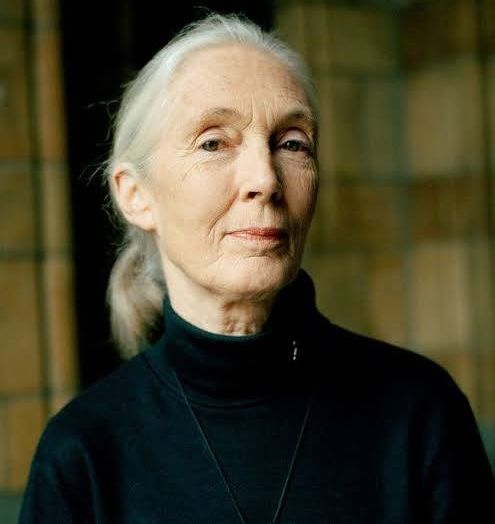
Jane Goodall
April 3, 1934—October 1, 2025
You cannot get through a single day without having an impact on the world around you. What you do makes a difference, and you have to decide what kind of difference you want to make. - Jane Goodall
Ever since Jane Goodall was a child in the 1930's, animals fascinated her. She would observe them whenever she could, such that she hid in her family's henhouse to watch a chicken lay an egg. Unfortunately, Jane did not have enough money to attend university, which halted her dreams of working with animals. Nevertheless, Jane was patient, and as she picked up other jobs, she continued to look for opportunities to work with animals. Her patience paid off when a friend invited Jane to a family farm in Kenya.
A few months into her visit to Kenya, Jane met Dr. Louis Leakey, a renowned scientist who was interested in learning more about chimpanzees. Jane worked for Leakey as his secretary, but when the opportunity came to study chimpanzees in the wild, Leakey thought Jane was the best candidate to do it. His choice of Jane would have appeared strange, as Jane lacked any formal scientific education. However, Leakey saw in her a willingness to persevere in her desire not only to study animals but also to have the patience to take the time to understand them. At the time, working in the field was uncommon among animal researchers and would pose new challenges. Jane was willing to immerse herself fully in the Tanzanian landscape, a land very different from her native England, a decision that demanded courage from a young woman setting off alone, without formal credentials, into work no one from her background had attempted before.
From her very first day in the field, Jane encountered setbacks. She immersed herself in the chimpanzee habitat, but the chimpanzees ran away from her. She could not make any observations if her subjects refused to be seen. However, Jane was patient, knowing that with time the primates would acclimate to her presence. Sure enough, the chimpanzees grew comfortable with Jane's presence, which allowed her to make fascinating new discoveries.
Jane was the first to notice that chimpanzees not only used branches to "fish" for termites but also stripped leaves from sticks to fashion them into the tools they desired. This observation revealed greater complexity of thought behind the primates' actions. Scientists had studied chimpanzees in controlled environments and had never witnessed this, but Jane's choice to immerse herself in their habitat, rather than confine her study to a laboratory, was itself an exercise in good judgment. She trusted what patient, direct observation would show her over the easier, more conventional path. Her long, careful, and extensive methods of observation, weighed and chosen with real deliberation, made it possible to see behaviors that no controlled experiment ever had. Jane set a new standard for animal research through this approach, one built on watching rather than intervening.
Jane's work extended beyond chimpanzees to promote nature conservation efforts. Jane worked to oppose deforestation and poaching that began driving chimpanzees towards extinction. She believed man is responsible for helping preserve the natural world. This conviction grew from the same respect she had shown the chimpanzees from her very first days at Gombe, regarding them not as mere specimens but as individuals worthy of consideration, a regard she extended to the whole of the natural world she had come to know. Jane promoted individual responsibility for finding ways to care for the environment.
Jane's life was animated by patience and perseverance, which helped her achieve her dream of studying animals, a field that would become important to future scientists. Jane is an inspiration to those who experience setbacks in pursuit of their goals and an example that a willingness to persevere yields results.