
Why the Cardinal Virtues?
by Michael Berndt, DIrector of Curriculum, Hillsdale College K-12 Education
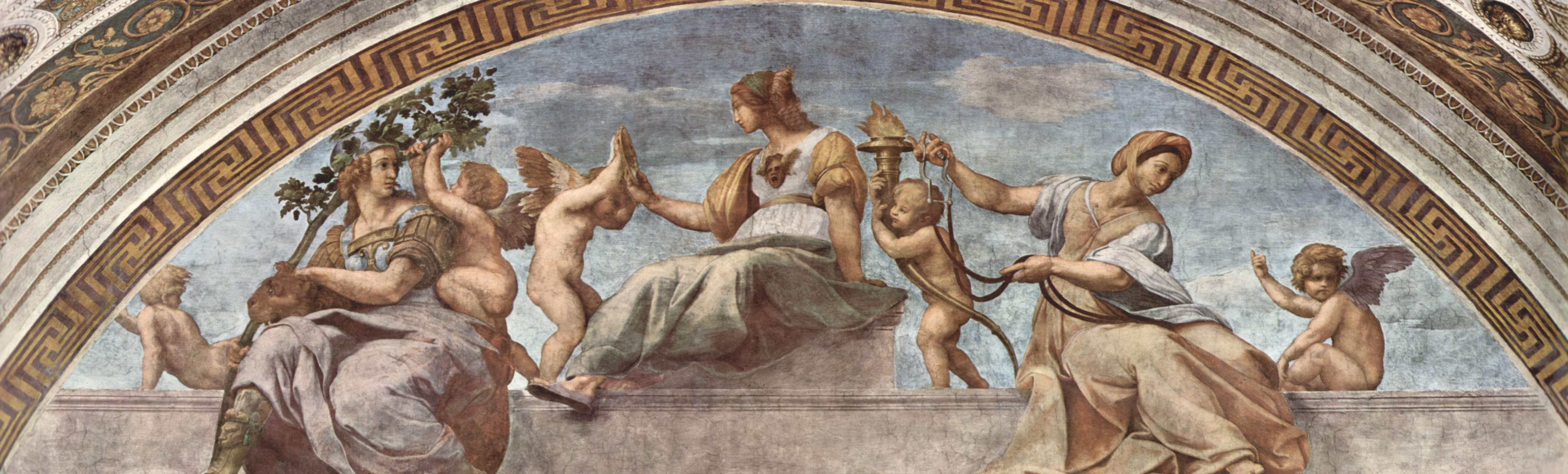
Anyone who explores this website will notice that many specific virtues are organized around four central ones: prudence, justice, moderation, and courage. These are the cardinal virtues (from the Latin word cardo, meaning "hinge") and they have been a cornerstone of Western moral thought for over two thousand years. In this post, we want to explain why these are the foundation for the Core Virtues program, and how they help to provide a framework for moral education.
A Perennial Tradition
The tradition of the cardinal virtues is not the invention of any single thinker. Plato first identified these four as essential to a well-ordered soul in his Republic. Aristotle gave them a more analytical treatment in his ethical writings, though he tended to lay greater stress on the multitude of specific virtues than on the unifying generalities that Plato pointed to. Some of the Roman Stoics and Neoplatonists were among the first to bring these insights together, organizing all of moral life around the cardinal virtues and stressing their importance for citizenship and statecraft. Latin Church Fathers such as Ambrose, Augustine, and Jerome later recognized the consonance of this tradition with the teachings of Scripture and readily incorporated it into their moral theology. By the Middle Ages, despite ongoing disputes about the relationship between natural and theological virtue, the four cardinal virtues provided a relatively unchallenged framework for moral life in the West.
The authority of the cardinal virtues, in other words, rests on common acceptance across centuries of reflection. It is a perennial tradition whose persistence itself requires explanation.
What Makes Them “Cardinal”
Such an explanation is to be found in human nature. The cardinal virtues have endured because they correspond to essential elements of good moral action, and this makes them exhaustive in a way that other groupings of virtues are not.
To see why, we must think about what virtue is and what it is for. A virtue, in the classical sense, is a good habit, which can be defined as "a stable disposition, acquired through practice, that inclines us to act well with consistency and ease." We need many kinds of habits to live and to live well, but the ones that matter most for character are habits of choice. These habits are the moral virtues: dispositions that shape how we desire and pursue what is good. When we speak of a person of good character, we mean someone who reliably chooses well and who does so readily and with serious intent.
What, then, does it take to choose well? The question is worth dwelling on here, because the answer reveals the underlying structure of the cardinal virtues.
A good person is one whose actions consistently accord with right reason. That is, a person is good when what he does is informed by a sound understanding of what is truly good for himself and for others. Now, there are really only four general ways in which our actions can be brought into line with right reason, and each one of these corresponds to one of the cardinal virtues.
The first is the most fundamental: reason itself must be set right with respect to moral matters. If we are confused or mistaken about what is good, then even the best intentions will not prevent us from going astray. The virtue that perfects reason in its practical role, enabling us to see clearly what ought to be done in the particular circumstances we face, is prudence. This virtue is often called the "mother of the virtues" because without it, we may do good things by luck or by obedience, but we cannot choose them through our own understanding; prudence, in other words, is what gives full life and existence to the other virtues. A child who obeys a prudent parent performs an objectively good act, but the rational excellence is in the parent's judgment, rather than the child's. Prudence, then, is what enables us to direct our own lives toward what is truly good.
The second way our actions are brought into accord with reason is by establishing what is right in external human works and affairs. It is usually not enough simply to know what ought to be done; we must also enact this knowledge by putting right order into our relations with others. This is the work of justice, which is the habit of giving to each person what is due, and thereby truly acting for the good of others, beyond the aims of natural self-interest alone.
If reason and will were the only motivating powers of human action, then prudence and justice would suffice for our goodness. But we are not only rational minds; we are also embodied animals who are moved by passions such as fear, anger, sorrow, and joy. These passions are necessary and good in themselves, but they do not always follow reason's lead. They can pull us off course in two broad ways, and each one of these requires its own virtue to correct it.
First, our desires can draw us toward pleasures and satisfactions that conflict with what reason knows to be good, either because we desire things we should not or because we desire things in the wrong way, at the wrong time, or to the wrong extent. The virtue that brings our desires under the governance of reason is moderation. It is worth stressing that moderation does not mean the mere suppression of desire; rather, moderation is a state in which reason permeates desire itself, so that we actually come to want what is good and to enjoy it rightly. In other words, desires that have been properly moderated by reason will themselves tend toward what is reasonable.
Second, our fears and aversions can cause us to shrink from goods that are difficult or dangerous to pursue, even when we know we ought to pursue them. The virtue that strengthens us to hold firm when our pursuit of goodness meets with resistance is courage. Like moderation, courage is not simply the forceful suppression of a passion; it is the formation of what may be called the “spirited” passions (such as fear, daring, or anger) that enables them to support reason in striving for justice and in fleeing what is unjust.
These virtues, then, describe the four general habits that are always required for acting well: reason must be sound in its practical judgment about what ought to be done (prudence); the will must be disposed to carry out what reason directs in the external realm of human action and operation (justice); our interior desires must not pull us away from what is truly good (moderation); and our internal fears must not hold us back from it (courage). Together, these virtues perfect all of the motivating sources of moral action that are given in our nature. The person who possesses these four habits thus has a certain completeness in goodness and a wholeness with respect to everything that is needed for right choice. For this reason, these virtues are called “cardinal,” since they are the “hinges” on which all other virtues turn.
Why We Need More Than Four
If the cardinal virtues are so comprehensive, one might reasonably ask why Core Virtues identifies additional ones, such as generosity, perseverance, humility, patience, and so on.
The reason is that the very comprehensiveness of the cardinal virtues comes at the cost of specificity, and specificity matters a great deal in the practical work of becoming good. Habits form through repeated action in particular areas of life, and they tend to develop piecemeal. Consider courage, for example: a person may be remarkably bold when faced with sudden physical danger and yet have real difficulty persevering through a long, wearying trial in which no dramatic act of bravery is called for. Both boldness and perseverance fall under courage, but they are different dispositions, shaped by different kinds of choices and experiences.
The same is true across all four cardinal virtues. A person may govern the desire for food and drink quite well but have real difficulty moderating the desire for praise and recognition, which is why we distinguish moderation from humility. Someone may be scrupulously honest in speech but slow to fulfill broader obligations of responsibility, which is why honesty and responsibility are distinct parts of justice.
The tradition of grouping more specific virtues around the cardinal ones reflects these practical considerations, while at the same time giving educators and parents realistic targets for cultivating moral character in children. It is often easier to help a child see what perseverance looks like than to tell her to aim for heroic courage, which may not be immediately available to her, given her age and her circumstances. But because these specific virtues are understood in relation to the more general cardinal virtues, we need not lose sight of the larger picture. We can always understand how each particular effort at moral growth contributes to the wholeness of a good character.
A Framework for Moral Education
The cardinal virtues, then, give us a coherent account of the distinct roles that reason, will, and the passions play in the moral life, and they provide a structure within which more specific virtues can be understood and taught. In times such as our own, when the language of virtue has grown thin, this kind of philosophical structure is especially valuable. It helps us to think clearly about what makes a human being good, about how particular areas of our moral lives relate to one another, and about what the challenging work of moral growth actually requires. Core Virtues is built on this tradition because we believe it remains the most illuminating framework available for the intentional formation of good character.