
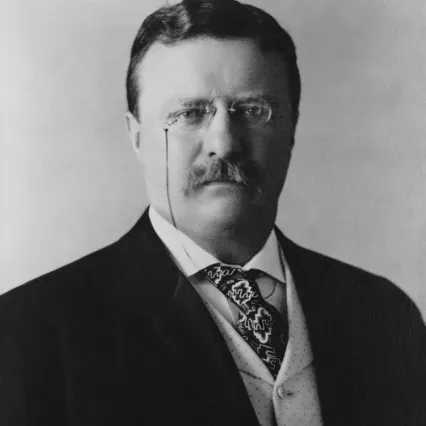
Theodore Roosevelt
October 27, 1858—January 6, 1919
I wish to preach, not the doctrine of ignoble ease, but the doctrine of the strenuous life, the life of toil and effort, of labor and strife; to preach that highest form of success which comes, not to the man who desires mere easy peace, but to the man who does not shrink from danger, from hardship, or from bitter toil, and who out of these wins the splendid ultimate triumph. - Theodore Roosevelt, "The Strenuous Life"
Theodore Roosevelt endeavored to live his life to the fullest, never shirking from opportunity. He lived as a rancher out west, commanded his "Rough Riders" during the Spanish-American War, served as president of the United States, and more. He pursued "the strenuous life," which was animated by vigorous activity, not just physically, but in all his pursuits.
Roosevelt was born in 1858 to a wealthy family in New York, but this did not mean that his life was all comforts. Roosevelt was a frail child who suffered from asthma. When he learned that he could strengthen himself through physical training, he began a commitment to physical activity that would continue throughout his life. This moment exemplifies Roosevelt's perseverance.
Roosevelt attended Harvard and spent a year at Columbia Law before deciding, after careful deliberation, to go into politics instead. He held many different positions in the State of New York, where he set himself apart from other career politicians. Other politicians would grant favors, often being lenient in their application of the law, to businessmen who supported their party. Roosevelt was completely opposed to this behavior. He believed that doing so was unjust and violated politicians' responsibility to uphold the rule of law. Roosevelt did not grant these favors, which made him unpopular within his own party. However, Roosevelt was unperturbed. His commitment to justice outweighed his peers' opinions.
When the Spanish-American War began, Roosevelt resigned as Assistant Secretary of the Navy and established a temporary cavalry unit, dubbed by newspapers as the "Rough Riders." The unit became distinguished for its bravery, notably at the Battle of Las Guasimas and the charge on Kettle Hill. Roosevelt and his unit were regarded as heroes not only for their courage in battle but also because the soldiers came from all walks of life, from students to athletes to frontiersmen, all moved by the same patriotism and committed to fighting for their country.
After the war, Roosevelt returned to politics as an even more popular figure. The Republican Party wanted to limit Roosevelt's interference and so nominated him as Vice President, hoping the position would prevent him from making significant political changes. However, President William McKinley was killed six months after winning the election, which meant that Roosevelt became president.
Roosevelt accomplished much as President. His good judgment in international affairs was on full display when he mediated the end of the Russo-Japanese War, a diplomatic achievement that won him the Nobel Peace Prize. He also oversaw the construction of the Panama Canal. Roosevelt remained steadfast in his principles against granting political favors and filled his cabinet with individuals whom he found to be mentally and physically capable, not selecting people merely because they supported his party. This same sentiment moved him to work against businesses he believed were operating unfairly. He also made great efforts towards conservation, setting apart more land than any other president for national parks.
Throughout his exciting life, Roosevelt remained resilient and persevered through difficulty, committed to the principle that, as a politician, he had a responsibility to ensure the proper application of justice.