
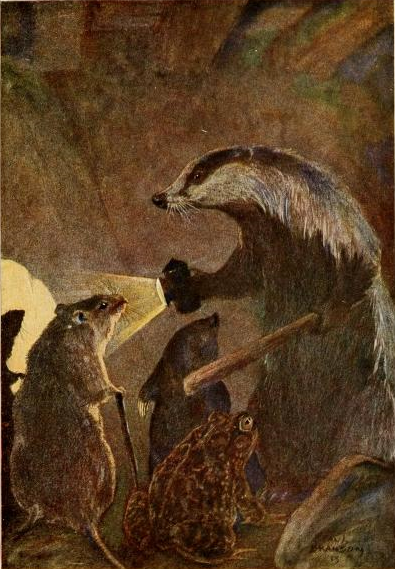
Virtues in The Wind in the Willows
by Lori Andaloro, 5th Grade Teacher
The Mole was quiet for a minute or two. But he began to feel more sad and more jealous of Rat, sculling so strongly and so easily along, and his pride began to whisper that he could do it every bit as well. He jumped up and seized the sculls, so suddenly, that the Rat, who was gazing out over the water and saying more poetry-things to himself, was taken by surprise and fell backwards off his with his legs in the air for the second time, while the triumphant Mole took his place and grabbed the sculls with entire confidence.
“Stop it, you silly ass!” cried the Rat, from the bottom of the boat. “You can’t do it! You’ll have us over!”
The Mole flung his sculls back with a flourish, and made a great dig at the water. He missed the surface altogether, his legs flew up above his head, and he found himself lying on the top of the prostrate Rat. Greatly alarmed, he made a grab at the side of the boat, and the next moment-Sploosh!
Over went the boat, and he found himself struggling in the river.
If ever a novel might be said to embody the cardinal virtues in their fullest expression, it is The Wind in the Willows. In chapter one, the reader is immediately confronted with the three elements of moderation: self-control, patience, and humility. Despite having no experience with boats, Mole ignores Rat’s advice, grows jealous of Rat’s rowing mastery, and forcibly takes control of the boat, causing it to capsize. Once Rat has pulled Mole to safety, set the boat aright, and recovered their scattered picnic effects, there follows what may well be among the humblest apologies in all of literature. Thus begins Mole’s time under Rat’s guidance, as a pupil in the school of life. Throughout the chapters are lessons on courage, moderation, justice, and prudence.
The Wind in the Willows was written to instruct and delight Kenneth Grahame’s only son Alastair. Each chapter is self-contained, making the book episodic in structure. Each chapter, in its turn, sets forth some single vice in contrast with its corresponding virtue. The teacher can treat each chapter as having its own larger moral meaning -the central lesson at the heart of the story. Grahame captivates readers with the lively antics of his charming animal characters, while subtly reflecting our own human nature through their behavior. Their adventures, as in all true classics, become our own by sympathetic participation.
Many of the chapters focus on Toad’s inability to practice moderation, at which he fails time and again. Toad’s immoderation meets its natural consequences: the constant destruction of his purposes. The scene at the Red Lion in chapter six is both exciting to read and powerful in its message. By this point, Toad recognizes that he completely loses control of himself around motorcars. His friends have “taken him in hand”, but he continues to ignore their advice suffering the consequences of his actions. While at the Red Lion, Toad hears a motorcar pull into the parking lot, and he betrays a common weakness: he is overtaken by desire for that which he covets. Toad’s descent into crime does not happen with one willful decision, but in a series of steps. He allows himself to first look at the motorcar; he then fixes his gaze on the car and starts the engine. With eyes, ears, and mind possessed, he loses control of himself and finds himself driving the car. Grahame writes, “the old passion seized on Toad and completely mastered him, body and soul.” As a result of his own incontinence, Toad finds himself justly jailed. It is not until the final chapter that Toad, from a position of self-knowledge, is able to show good judgment, acting in the pursuit of the good of those around him.
Friendship is another prevalent virtue interwoven through the entire fabric of the book. One might even say it stands as the very heart of the story. With abundant examples, students will be able to discuss how to be good friend, what it means to be a good friend, the differences between friends, and how we adapt to those differences. Chapter two includes a touching example of friendship. Toad is on to his next new thing: caravans. Just as he is about to go on his camping trip, Mole and Rat show up. Rat has seen this all before, and he does not want to go along on the trip. Mole, however, is captivated by the idea, and ultimately Rat agrees to go along for Mole’s sake. At the end of the first day, they camp out for the night. Toad gravely offends Rat by making fun of his river. Toad falls quickly asleep, but Mole is there and he hears him and he is paying attention.
The Mole reached out from under his blanket, felt for the Rat’s paw in the darkness, and gave it a squeeze. “I’ll do whatever you like, Ratty,” he whispered. “Shall we run away tomorrow morning, quite early- very early- and go back to our dear old hole on the river?”
Rat responds by telling Toad that they will stay. Rat directs his attention to his friend Toad and tells Mole that he “ought to stick by Toad till this trip is ended.” Even though Rat has been insulted by Toad, he puts his thoughts on what his friend needs. Mole learns from this incident. Later on in the story, Rat will need a strong confidant and committed friend.
In The Wind in the Willows, courage is not chiefly a matter of outward bravado, but of quiet steadfastness, faithful friendship, and the overcoming of inward fears. It is seen when the characters endure the perils of the Wild Wood, when they join together to recover Toad Hall, and when they show the harder courage of speaking truth to a friend for his own good. In chapter three, Rat acts courageously as he enters the Wild Wood to find Mole, who has gone against Rat’s advice to stay away from the dangers and “the Terror of the Wild Wood.” Fear can be present when someone is acting courageously. In the classical sense, courage is not the absence of fear, but the right response to it. Rat’s courage is meaningful because fear is part of the moment. Throughout the book, courage is shown as fear rightly ordered and overcome by duty, love, and virtue. In chapter twelve, the taking back of Toad Hall is humorously compared to the return of Ulysses. After Toad’s time in jail, he returns to find his beloved hall taken over by the stoats and weasels. In a grand gesture of courage, his friends avenge Toad and take back what is his.
The Wind in the Willows is a journey of growth in virtue for our students. It is a classic story that tells us something about humanity. It tells it in a way that is imaginative and clever. Part of the teacher’s job is to help students recognize and love that which is good, true, and beautiful. Grahame renders it natural and inviting for readers to accompany the characters on their journey and, in doing so, to cultivate these virtues along the way. The Wind in the Willows calls us into a great conversation. Grahame makes it easy to enjoy the story, making it possible for us to create a generation of lovers of great literature and virtuous young men and women.