
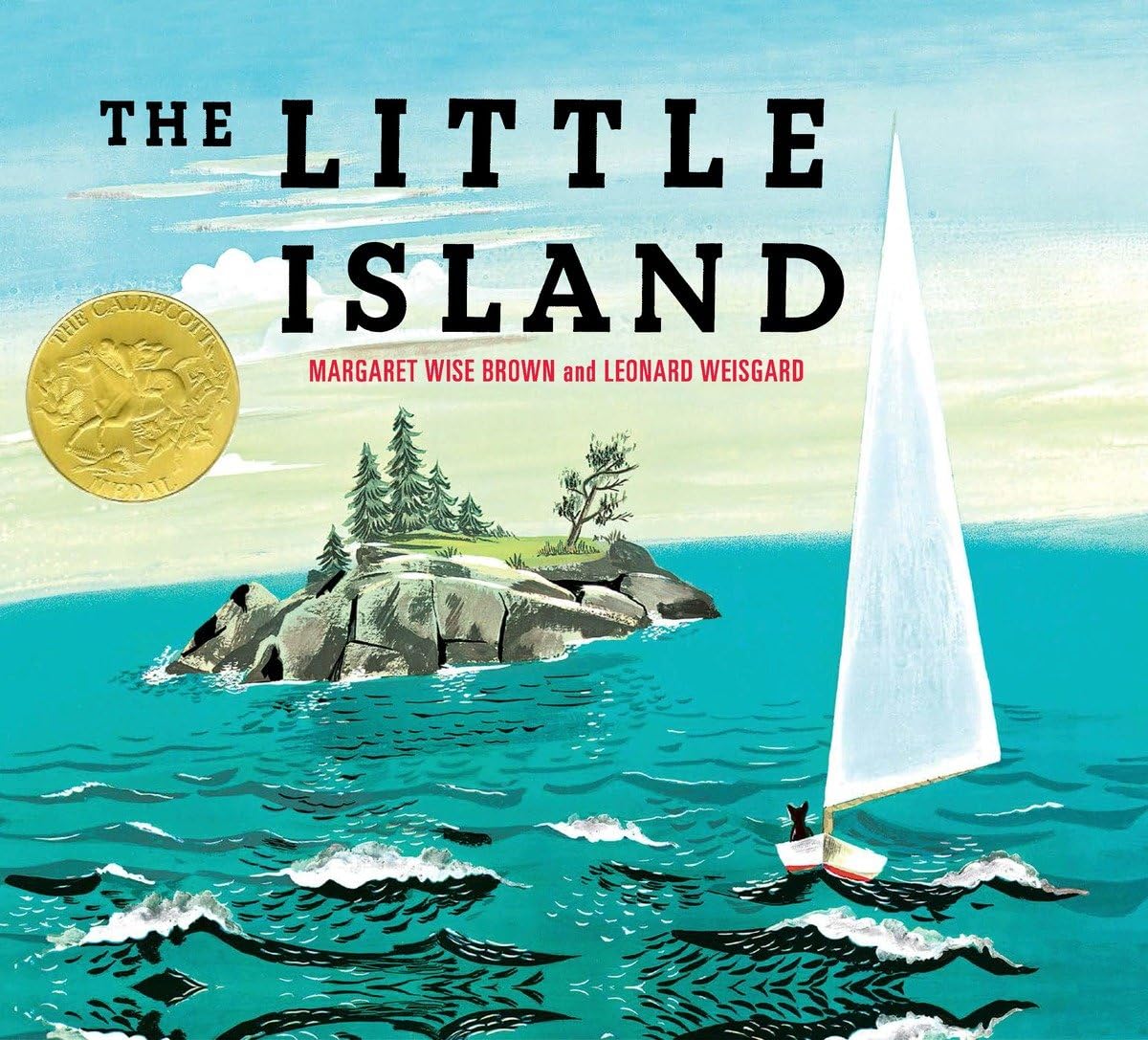
The Little Island and the Purpose of Children's Literature
by John Peterson, Assistant Director of Curriculum, Hillsdale College K-12 Education
The Little Island is a little island of a story surrounded by an ocean of what seems to be inconsequential detail. Ten pages of description are followed by a short story. In the span of five pages, a cat visits, has a dialogue with the Island and a fish, and leaves. Five more pages of description follow.
Just so, we live our lives, children come—whether as students, or our own progeny—then leave us to continue. What do we teach them while they are with us? This, whether Margaret Wise Brown (writing under the pseudonym Golden Macdonald) understood it this way or not, is what The Little Island is about.
We are the island; the cat (alternately and unpredictably called a “kitten”) is the child; and the fish, to whom the Island has recourse as teacher, is the book.
And the fish told the kitten
how all land is one land
under the sea.
The cat’s eyes were shining
with the secret of it.
And because he loved secrets he believed.
This is a description of children’s literature at its best: an initiation into a mystery. The mystery is not amorphous or incomprehensible but promises a deep connectedness of meaning: “all land is one land under the sea.”
The fish had invited the kitten to come with him “down into the dark secret places” to see how the Island (always capitalized) is connected to the land. The fish wants to share his knowledge with the kitten directly, the way he has experienced it. But the kitten can’t swim. “Show me another way,” he says, “or I’ll eat you up.”
Kids are always saying this, in one way or another. Make this make sense for me in a way I can understand. Our high-minded explanations, full of incomprehensible causes and morals, confound and dissatisfy them, and we find them acting and speaking with surprising impertinence. “I thought I taught you better than this.” No: “Show me another way, or I’ll eat you up.”
The other way turns out to be a kind of submission to authority:
“Then you must take it on faith
what I tell you,” said the fish
“What’s that?” said the cat—"Faith.”
“To believe what I tell you
about what you don’t know,” said the fish.
Remarkably, what the fish tells the kitten is merely what the Island had claimed, that it is “a part of this big world,” and not cut off from the land. Why does the kitten not believe the Island? Why does it need to hear from the fish? The Island is like the parent with his or her own life and experiences, but for the child, it is only “daddy” or “mommy.” The child must learn that just as he is a person with relationships with the world, so are his parents. He can only learn this over time, slowly being introduced to the world as his parents see it, and by observing his parents’ relationships with others.
When the kitten first comes to the Island and finds it surrounded by water, he declares, “What a little land. This little Island is as little as Big is Big.” The Island responds by telling the kitten that he, too, is little, and then the kitten says, “Maybe I am a little Island too,” and leaps in the air, to be disconnected from the land, as he thinks the Island is. The child playfully imitates his parents. But the Island, surprisingly, agrees: “That is just what you are”—the kitten, too, is an Island, a person distinct from others, but intimately connected to the world. The confusion elicited by this agreement, and the Island’s insistence that its feet, like the kitten’s feet, are also “on the world,” is what provokes the dialogue with the fish, the recourse to faith, and the kitten’s belief. It is not an answer, but it is an account, one that acknowledges the profound depths of the mystery of meaning we invite children into, and at the same time, the simplicity of access to the world of connection between things.
Margaret Wise Brown’s work captures this depth and simplicity well. Her world is a world of things, of things that can be named and counted and which have being, that is, particular meaning that is not reducible to measurable qualities, but which is sometimes revealed or obscured by them. We see this in the descriptions that surround the story of the kitten and the fish. The Island remains a thing, even as:
Around it the winds blew
And the birds flew
And the tides rose and fell on the shore.
Clouds passed over it.
Fish swam around it
And the fog came in from the sea
and hid the little Island
in a soft wet shadow.
We follow the days and seasons on the Island, and all its visitors, from spiders, lobsters, seals, and birds, to boats, storms, and of course the kitten, all beautifully illustrated by Leonard Weisgard. His speech accepting the Caldecott Medal for his work on the book is well worth reading.
He describes how the book captures the experience of children. There is something foolish and romantic in his account, but also true:
I remember the crazy pleasure of standing in puddles, and that great desire to animate all dead things. I remember in the summer heat, blowing on flies and expecting them to believe winter had returned. I remember that disturbing feeling, believing grown-ups could see my thoughts. These first experiences, which we so intensely felt, had sometimes real meaning. And when the meaning was too deep to explain, this would then become our magic. As we grow older and taller, we do seem to forget this magic and some of our original truths.
The lesson to be drawn here is not that children are wiser or that we ought to be more like them, although a graphic artist likely must maintain some of the imaginative innocence of childhood. Dead things do not live, flies do not believe in winter, grown-ups cannot see your thoughts, and kittens do not have dialogues with fish. The lesson is that the freshness of experience contains an imaginative power that ought not to be intruded upon by what Weisgard calls “manners or sentiment”; rather, that imaginative power must itself be harnessed to introduce children into the clarity and beauty of being itself. The error of supposition in itself, the fantasy-magic causality of childhood, ought not to be worshipped but harnessed. The kitten questions the Island because he wants to know, and he believes the fish because he wants to believe.
What is admirable in children and ought to be carefully guided, as demonstrated by the kitten and by The Little Island itself, is the combination of humility and audacity, of simplicity and depth. The child wants to know the secrets of the universe and also to know that the woods on the island have “seven big trees,” “seventeen small bushes,” and “one big rock.” He names, counts, and identifies things and leaves it at that, and then, in fleeting moments, demands to know how everything and anything is “part of this big world.”
It is a real island, by the way, one that Macdonald/Brown knew well, “a real little island off the coast of Maine,” Weisgard says, where “the sea is never still, the clouds fly quickly into different shapes, the colors change from sunlight to mistlight, the trees are moving, and the birds are always flying and screaming.” It sounds like childhood. As Weisgard puts it, “You already know it. You know it in your own lives, you know it in what is written, in what you see and hear and feel, and with children all around you.”
The Little Island may not be perfect children’s literature, but it is an almost perfect account of children’s literature, and of the experience of trying to introduce a child to the world, teaching him that:
…it [is] good to be a little Island.
A part of the world
and a world of its own.
all surrounded by the bright blue sea.