
A Noble Task Worth Pursuing
by Gabrielle Lewis, Core Virtues Director
It was 2014, and I was a new fifth-grade teacher, in the thick of my first year of teaching at a brand-new classical charter school in Spring Hill, FL. I had just graduated from Hillsdale College the May before, so the lessons, the rich learning, and the friendships I had experienced there were still fresh. I had almost no idea how to actually teach (bumbled my way through a lot that first year--how many new teachers can relate to this?!), but one thing I knew was the power of the books that I had the privilege to read with my students and the positive effect that they could have on their hearts and minds.
Although I enjoyed reading as a child, I did not fully appreciate its value in my life. Despite having a father who was an avid reader who talked (and still talks) about books ad nauseam, and my mother read books to me when I was little, I was not inspired to read. Reading books for school felt like a chore. In elementary school, the only book that stands out in my memory was a book my fifth-grade teacher read aloud to our class – Holes by Louis Sachar. And the only reason I really remember it was because it was turned into a movie the same year, which is why my teacher chose it in the first place. Otherwise, we read “Language Arts” stories—stale, boring, vapid. Not the kind to awaken the desire to read and read well. In high school, we read some great stuff, Shakespeare, Chaucer, Golding, Bradbury, but these were all read (at least, if my memory serves me correctly), with literary criticism and formal literature instruction (like “What literary devices does this author use?”) in mind. While these are fine things, I do not remember my teachers teaching me that these works were a part of a greater conversation that had been ongoing for millennia. Never did they allow the authors to metaphorically (or literally) speak to each other, or to have me learn through this dialogue. Instead, I felt like all these stories were disjointed and completely unrelated to one another – like puzzle pieces given to me with no way to know which puzzle I was putting together, no box top image to see the larger framework of these great works. I felt like my teachers were having us read them with the issues of the day in mind, and I most definitely felt like there was an agenda to it all. So unfortunate that this was my grade school experience. Looking back, I feel robbed of the value of a true education. So, thank God for Hillsdale College!
It wasn’t until I attended Hillsdale that I had inspiring professors. They were knowledgeable, sincere, wise, gentle, and commanding. They allowed the texts we read to speak for themselves, but they also knew how to guide us thoughtfully toward deeper, more thoughtful thinking through great questioning. Finally, I was made to see that all knowledge is interconnected—that my learning and reading were allowing me to participate in a greater conversation—THE Great Conversation. Finally, I had the box top for all the puzzle pieces I had been given before. It gave my life a deeper, more beautiful meaning than I had previously known to be possible. But it wasn’t until I took a college course on Classic Children’s Literature that I began to understand the power of these stories. I had read a few children’s classics outside of school on my own and enjoyed them, but again, I had no framework to appreciate them appropriately. The professor of my Children’s Literature course opened a new world to me through these stories, and for the first time, I was introduced to the power of story and its impact on a child's formation… Dang! On the formation it could have on me, at 20 years old! My heart and mind were captured by the characters and ideas within, as well as by this grand concept of “the moral imagination.”
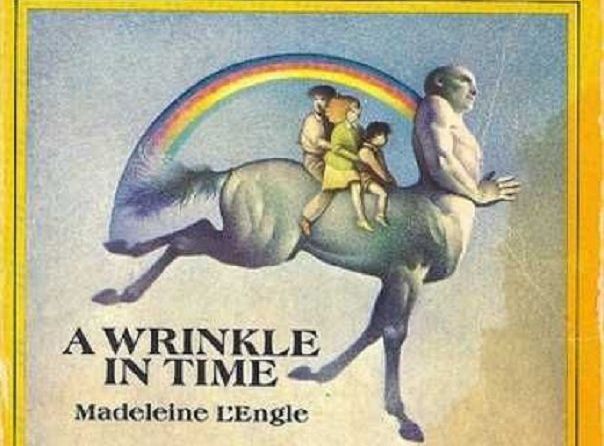
So here I was, only a couple of years later, teaching literature to my fifth graders and desperately wanting to have the same impact on them that my professor had on me—a very different one from my elementary experience. We had quite the line-up, and I had a tall order in doing justice to these stories—books like The Lion, the Witch, and the Wardrobe, Treasure Island, Tom Sawyer, and Anne of Green Gables. I knew these books well, in large part thanks to my college course. I loved these books, so selling them was easy. If you’ve been a teacher of young people for any length of time and you have a good relationship with them (which is a must if you hope to affect them in any positive way), you know how easily they learn to appreciate the things you love. But there was one book I wasn’t so sure about—A Wrinkle in Time by Madeleine L’Engle. My courses hadn’t explicitly prepared me for this one. Before encountering it with my students, my only experience with the novel was reading it once in 4th grade and thinking it was the most bizarre thing ever. There was this word that was repeated over and over (tesseract) that I could barely pronounce, time-travel, supernatural beings, a telepathic brain, and the list goes on. I just couldn’t get into it.
Well, here I was, years later, having to read this story with a discerning eye and do it justice for my students. It was a classic after all, so clearly, I was the problem. As I learned about the story behind the story (i.e., L’Engle writing it to reflect the anxieties of the Cold War era and the fears of totalitarian regimes that force conformity in exchange for freedom, and how love and goodness conquer darkness and evil), I suddenly had a newfound appreciation for this science fiction novel.
As we worked through the book, it was easy for me to ask questions to help my students understand what was happening and to help point them to the deeper purpose of the book. They related to Meg’s awkward, teenage ways (10 and 11-year-olds are awkward, too). They found adventure in all the space-time travel, and they desperately wanted to learn what happened to Meg’s father (who disappeared years earlier while working on a secret government project). When we learned of the “Dark Thing,” a malevolent force threatening the universe and the planet Camazotz, where conformity reigns and individuality is suppressed by the Dark Thing’s control, my students were genuinely intrigued to learn what this “Thing” was and how it would be conquered. They were hooked. So, when we met IT, a sinister, telepathic brain that controls the inhabitants of Camazotz, I knew it was important for me to pause, to focus on this character who is so obviously inhuman. To realize its significance, unlike me when I was younger. Delicately, I asked what they noticed about the character. (My students’ responses: “He speaks through people’s minds,” “He doesn’t have a body,” “He’s no good,” “He’s just a brain!” “Gross!”) I pushed further:
- “Why do you think Madeleine L’Engle made this evil character a brain with no body?”
- “How is IT different than you and me?”
- “What do we have that IT doesn’t?” (“A body. Yes…”)
- “We’ve talked before about the importance of growing not only our minds but also our _________ to become a more flourishing human being.” (Students: "Our Hearts!")
- “What is IT missing?” (Students: “HIS HEART!”)
- “Why is that significant? I mean… Is that significant?” (Students: “That’s why he is evil!”)
In that moment, they got it. They saw a picture of a character who was too much reason and not enough heart. A character influenced by a dark force that formed his mind with a bent toward evil and control. With no heart, he couldn’tbe softened to see his subjects, the citizens under his control, as persons who deserve freedom and dignity simply because they exist. With no heart, he lacked the compassion, kindness, generosity, justice, respect, humility—the virtues that human beings can and should cultivate. No wonder Camazotz was a miserable place!
So, what was I doing here? I was attempting to paint a clear picture for my students of what it means to be human, that it takes intentional development of our minds AND hearts. I was hoping they would realize for themselves that they would NOT want to be like IT, and instead desire to be like Meg, whose courage and love broke IT’s curse in the end. I was attempting to awaken the moral imagination through a great story and questions to guide them along their journey.Because my moral imagination wasn’t affected by this story years earlier, it was even more important to me that it have the opposite effect on my students. Thanks to my college professor and my education at Hillsdale College, I had a vision for what sort of outcome I hoped to inspire in my students, not just for their short-term gain, but for the ultimate effect it (and our many conversations over the school year around our books, content, and experiences) could have on them in the long run. As educators, we aren’t simply concerned with forming good students (although that is important), but we know that being good students, good readers, or good writers serves a larger goal: being good people. We care just as much about who they are at 10 years old as we do about who they will be at 40 or 80. As Vigen Guroian, author of Tending the Heart of Virtue, says, the work we’re doing here through story (and beyond) “…is about making virtuous persons, and it is about cultivating the child’s soul. It is about building up in a child a moral imagination that will serve her throughout the whole of life.”
Core Virtues seeks to partner with educators, whether formal classroom teachers, school leaders, or parents, to provide books, such as A Wrinkle in Time, that aid in forming moral character through furnishing the moral imagination. Through time-tested, powerfully written, and beautifully illustrated stories filled with timeless truths about humanity, we can reach the hearts of the young and inspire them to love that which is Good, True, and Beautiful. It’s a noble task worth pursuing with all our might.